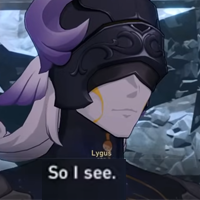
Resolve of a dead man: When E5 meets regret
22.12.2025Lygus from Honkai Star Rail: 5w6 so/sp 513 LSE EVLF
Zandar: 5w6 so/sp 513 ??? ????
Someone who wanders the stars. Someone who seeks answers with abject despair. That is all I am.
This time under my metaphorical scalpel (and a screwdriver) ended up a most unexpected guest, whose psychology seems so fascinating to me that I'm afraid even the subject would be creeped out by my dedication to unravel this mystery. This analysis will be long and ranty, enough to set the atmosphere suitable for our favorite Emanator of endless yap, but perhaps a bit too personal and biased for his liking.
Of course, we can't just talk about Lygus without also bringing a somewhat dead and probably very tired Zandar into the discussion. Typologically, I don't believe he and his fragments have to be similar, and the theme of Enneagram Five is probably going to stop at Lygus, if Zandar's story doesn't end there altogether. There is enough known about Zandar for me to conclude that the both of them share the Enneagram types listed above, along with some other details, and this will come up throughout the analysis.
So what makes Lygus so interesting, typologically speaking?
His combination of types seems like one of the bizarre and contradictory ones, but there actually is no contradiction, and instead a very beautiful subversion of all expectations. Zandar and Lygus reveal a very sad reality of Fives and offer many insights into the inner workings of this type (but no solutions, sadly).
Besides that, Lygus is the perfect subject for case study of 'differential diagnosis' (as I call it) of types commonly seen as artistic. He has exactly zero SX, no signs of Four-ness whatsoever, and is a Sensing type in Socionics, yet is still, in his own way, an artist with a drive to create, to destroy, and with a taste for theatrics. He really goes to show the unique way in which even such a machine-like and 'dry' combination of types can possess an emotional depth and a degree of barely contained insanity that the more 'artistic' types are oh so proud of. This conundrum is easily solved once I direct your attention to Psychosophy, specifically 1st Emotion—the actual artist.
One thing about 1E that becomes apparent once you actually get to know them, is that they aren't as much emotional as they are inspired. It's like they have a 'Muse' that they follow throughout life, that in extreme cases can border on obsession (2E/3E can also relate, but they are in control instead of being controlled by their states of inspiration). This is a different kind from the obsession of SX types, which, in the latter case, wants to infect and be infected. But 1E without SX can chase their obsessions while still maintaining perfectly firm boundaries like impenetrable walls (conversely, 4E with SX can participate in the 'fusion' game without getting sidetracked). And all of this is also different from being driven by ambition... Well, this is getting complicated.
Psychosophy. Conversationally synthesized meaning
How beautifully it aligns, revealing universal truth in such simple terms.
I'm about done explaining 1E, so I'd like to draw attention to the phenomenal work of Lygus's EN VA that amplifies this aspect even further. As far as I know, Lygus is way less emotional in other voice-overs. While either works for him, I still express my partiality to his EN voice, as I believe it does a great job bringing out Lygus's most interesting qualities that make him stand out from other cold and unfeeling antagonists. His lack of feeling is just a façade, and he's not fooling anyone with it. And that's the point. His EN voice makes it sound like he's so overwhelmed by emotion he can barely hold himself together, and in my opinion this really fits Zandar's paranoia.
The way Lygus expressed his 2nd Will is limited but it's' so funny to me how he just can't stop praising everyone. He keeps doing it, complimenting even those who couldn't care less for his flattery! There could be an idea for a drinking game, but one seriously risks dying before finishing a single chapter. This absurdity is actually very easy to explain. The 2nd function looks for Process by offering pity and compassion, because it's a Strong function that has enough energy to spare for others. It's not a stretch to say that Lygus expects others to constantly seek reassurance, so his endless flattery is actually a request for Process, to lend help in development of Will. I said that his 2V is limited because his request is never answered, but if someone were to actually take the bait, I suspect Lygus has more wisdom and motivational speeches prepared that we didn't get a chance to hear.
Now, the aspect that drives the players crazy and likely triggered Lygus's downfall. It's his 3rd Logic. While you could argue that he just likes the sound of his own voice, I don't think that's it. He makes it very clear that his incessant talking is a genuine attempt to get his point across. His unequivocal belief in verbal communication is something to be admired, really. And this is one of the defining aspects of Process Logic.
What 3rd Logic wants, is for its expressions of thought to be understood correctly, because of its skepticism about the nature of thought and knowledge itself. Being a Process function, it needs a supply of feedback. 3rd function in particular looks for feedback constantly, because it doesn't have an inherent sense for what is adequate in its aspect, which is where the 'yapping' of 3L comes from—it's trying to calibrate itself. 3rd Logic is an eternal student in discussion.
Being able to offer an understandable explanation of one's thought process is of paramount importance to Process Logic, more so for 3L, for estimation of one's faculties. Because if one can't define an idea in a way that would make sense to someone else, how does one even know it's 'true'? Do one's thoughts alone offer any value at all as representation of reality? Can one even reason?
The cosmos made a mistake in calling me a genius. I do not possess more wisdom than those who came after me. I was just the first to touch upon the universe's border, and the first to define 'the prime mover of life' with incorrect logic.
Process Logic is rarely ever explored in works of fiction. While 3L isn't uncommon, the world is nevertheless dominated by Result Logic types who will find this topic neither interesting nor relatable, so even though you will stumble upon 3L characters everywhere, the likelihood of this aspect being the focus of their characterization is low.
Lygus is perhaps the most exceptional exception to this I've seen. 3L is one of the focal points of his characterization. This is his weak point. He wants to be the smartest person in the room, but is aware of his limitations in the department of reasoning. This is precisely what his deal is with the allegory he keeps referencing—it speaks to him. It's about the uncertainty inherent to knowledge. And as a fun trivia, Socrates—the one narrating the allegory of the cave in Plato's Republic—also was a 3L type (contrary to what Afanasyev believed). Coincidence? Not at all.
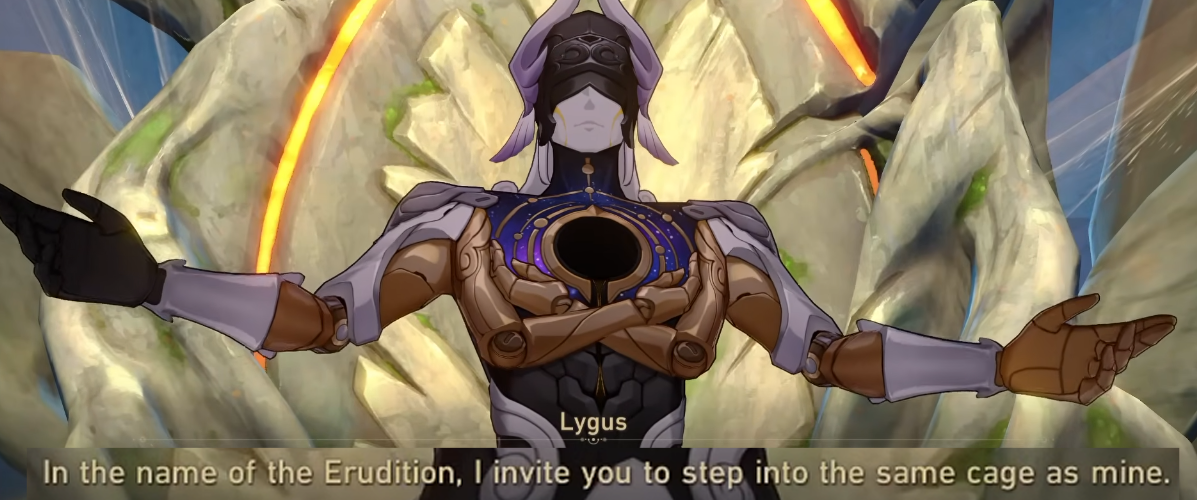
With Logic being a conversational aspect, loneliness affects Process Logic in a special way. It's possible that Zandar may have experienced the loneliness of not having an intellectual equal to partake in meaningful conversations about complex ideas, and it left a scar. This is ultimately the fate of all 'smartest people in the universe', but it hits Process Logic harder because it works by having its ideas bounce off other people. Without another to throw your idea back at you, it hits a wall and is left to stagnate.
Stagnation of ideas is a death of Process, and to Lygus this is unacceptable. By being omniscient, Nous defined the limits of ideas. If THEY already have all the answers, then every question has reached its conclusion, rendering the process of learning and the path of Erudition meaningless.
Socionics. Peripheral existence
Pick up a feather, and you can imagine a bird's song. Therefore, a single feather is a singing bird.
The MBTI folks are going to short circuit at the thought of Lygus being a Sensing type, but it's actually a very simple and hardly surprising conclusion to make. Have you seen his boss form? Clearly he's not a frail scholar While his Extroverted Intuition is relatively well developed (observe quote above), that's not enough to pass as Intuitive, which is precisely what makes Socionics so much more fun than MBTI. The Sensing in question can be observed in multiple ways.
Firstly, Lygus is not above brute force and violent threats. While the Activating Se of LIE and EIE is a whole another kind of monster, it is the way he would only ever take the stage in the Extroverted Sensing war games of power to prove a point—and be entirely confident that he can—that reveals a Strong, but not Valued, Demonstrative function. He doesn't want to do this, but you're leaving him no choice, man.
Secondly, a lack of creativity in Lygus's methods points to Weak Intuition. His solutions to problems are indeed rudimentary. Something's standing in one's way? Destroy it. Very simple. And his 'repetitive and uninspired' attempts are something that even Phainon commented on.
Thirdly, while patience may be a virtue, his complete lack of a sense of urgency is evidence of PoLR Ni. For someone who's supposed to be Zandar's paranoia, Lygus seems way too relaxed most of the time. A leisurely attitude towards life and aversion to hurry are indeed characteristic of an Si type. It's not a typing criterion by any means, but there is not much else going on because what defines Lygus is problematic Intuition, rather than a significant presence of Sensing.
Then there is the matter of Quadras. Peripheral Quadras are evil because we don't want to interfere too much. Joking. Indeed, we much prefer to joke around instead of doing politics and whatever the latest mass psychosis that Central Quadras are having. This may sound like a tangent, but if you connect this back to Lygus, you can see how he is unwilling—and unable—to establish partnerships or win over powerful forces across the cosmos that could help him reach his goal. A goal that, mind you, will affect the entire universe, so there is bound to be someone who would want to have a hand in this. He's a genius, but not crafty or cunning. He would always go it alone and hope that it works out, because with his lack of understanding of how Central Quadra stuff works, he really has no other option. It's a bit sad, but that's just how most Peripherals roll. It's a lesson in choosing your battles.
I like the next quote a lot because it succinctly demonstrates a preference of Extroverted Thinking over everything else, but elevated to an extreme.
The value of any formula resides only in its answer.
As for the process of solving it... No matter how elegant, violent, solemn, or humorous...
It is all utterly meaningless.
The first part shows a result-oriented, objective kind of thinking that places answers and truths above the underlying principles that make these truths possible. The second part suggests a disregard for both Fe and Se as merely some of the possible means to an end. And out of all this, only conscience—or, translating to my language, Fi—was ever able to shake Zandar's resolve.
Enneagram. Love as interference
I'm a fan of stories that show the clash of e2 and e5 philosophies, because when it comes to the idea of 'love', these types seem to me like two sides of the same coin. And here we have a fantastic premise that Lygus so neatly summarized in act IV of Cyrene's saga in As I've Written:
'Love' answers to many names.
Variables. Interference.
Symmetry broken. The original flaw.
Love and Destruction are two sides of the same force.
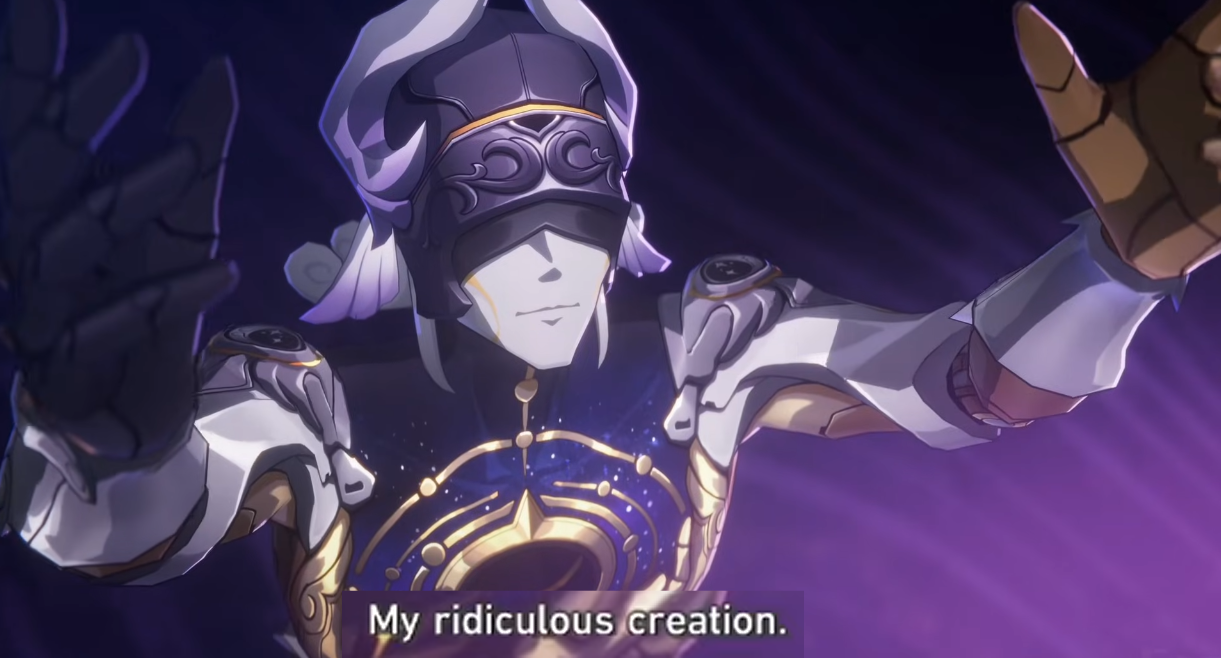
Zandar's story revolves around regret and disappointment that comes from the drive towards creation, that he then tries to counter by returning the universe to a state before his attempt at creation got the chance to break the symmetry. Zandar must have put all of his resources, all of his love into his passion project, but it only ever brought him eternal regret and failure. Not being able to experience the joy of creation without it eventually turning into its opposite, he concluded that love and destruction break things in much the same way. Love is the flaw that disturbs the perfect symmetrical state of things. But this conclusion has its roots in psychological patterns that were always present in Zandar.
After accidentally creating an Aeon, Zandar erased his works because of a sudden realization that he was leaving too much of an impact, to the point that he completely lost all control over the hows and whys of doing so. The result is a very ambitious man turned invisible and paranoid after what would seem to anyone else like a complete success that would have set him up for the rest of his life. He essentially vanished out of shame for being too involved.
Those writings and inventions... including the 'Complete Zandar One Kuwabara'... shall leave no trace in this world.
Now let's extrapolate by applying the Enneagram. Type Five is part of Rejection Triad in object relations theory of the Enneagram. What defines Rejection types is separation—they want to remain untouched. To that end, they make 'offerings' pertaining to their type's Center as part of negotiation with the outside world. And what Lygus does, is strategically laying out all of his cards on the table, with this essentially saying, "I'm giving you all this information, now take it and stop interfering". It may not make much sense to others, but to him this is a negotiation.
You can either accept my sincerity or face the consequences of defying it.
These are his terms of engagement that are immediately set in place, so you can either honor the agreement (the one that you accepted by engaging with him to begin with), or become an untrustworthy intruder in his eyes.
This may sound unreasonable, but that's just the Rejection Triad's modus operandi. Now you have to attend Lygus's lesson on history and philosophy because that's what he assumes you agreed to. There's a desperation to it, a desperation for conversation and understanding. Rejection types hold out so little hope, that when the subconsciously awaited opportunity for openness presents itself, they use all of it and then some more, disregarding whether or not the other person is ready for this pure stream of energy from its respective Center (Mental Center in case of type 5). And Lygus really didn't hold anything back when it comes to offering information.
Rejection types live up to their name by rejecting the part of them that is receptive and therefore vulnerable. Type Five disconnects from their human side, the one that is 'raw' and is constantly under attack by outside influences, thereby also rejecting their ability to give and receive love. This is why Fives so often feel like incomplete persons that don't have the inherent capacity to do some of the amazing things that others can do, and that their involvement won't bring anything good.
It's as if they are mocking me, a failed sculptor, whose touch can only diminish what was born to shine, until nothing remains.
Now, you could argue that Zandar learned this mindset after his supposed countless failures (countless in this case being his only two 'sculptures'). But I'm here to tell you that's not how psychology works; we all have an innate response to failure that is unique to a person, and to an extent is dictated by the person's types. Of course, by virtue of the brain's plasticity, one can cultivate a more healthy response, but there is always that same initial reaction that a person falls back on if left unchecked. So you either fight an uphill battle against the patterns engraved in your psyche, or continue reinforcing them in an endless feedback loop. And type Five's initial assumption is, my involvement spells disaster.
Involving oneself in anything at all ultimately means subjecting oneself to outside influences. And after Nous's ascension, the terms changed. It was no longer the universe that Zandar agreed to involve himself in. It became something completely different and something Zandar found lacking. Lygus mentions multiple times that his first creation 'left' him, and projected his own fury of betrayal on a Scepter that Nous also cast aside. Betrayal is a failure to uphold an agreement, it destroys trust. Trust is already something that Fives very much struggle with, because it means offering up a part of oneself. When that trust is broken, it reinforces the type Five idea that the world will try to take away pieces of them if given the opportunity. So not only does this make it difficult for a Five to fully engage, an undesirable outcome will also turn into regret, and resentment. Zandar felt apprehensive when building the astral supercomputer, but decided to trust the process, and paid for this dearly when his creation took away the only thing he found worthwhile—learning.
There is one aspect of Lygus that goes overlooked. The reason Trailblazer was allowed on Amphoreus in the first place, is because Lygus was actually awaiting their arrival all along—they were his only hope of ever breaking the endless cycles. Up until then, he was driven by inertia, feeling powerless to change anything. But there was, in fact, nothing to justify such a feeling. Lygus made minimal effort to break the cycles, instead preferring to continue observing and await some kind of perfect miracle that will help him make progress but without completely ruining everything, which is ridiculous.
Looking back, when "Zandar" was a human, he often felt trapped.
While Weak Intuition explains a lack of urgency and creativity, it is fear that makes him feel helpless before the will of the universe. The psychological inertia of type Five is of a specific kind that comes from the fear of involvement I explained above. If one is anxious about disturbance, then one will consider that disengaging from life completely is the best chance one has of holding on to what little one has left. The already 'small' and insignificant, in the grand scheme of things, personhood of type Five is something they feel they can't afford to lose, which is ultimately the cause of Enneagram 5 tragedy. Being left with nothing but curiosity and a longing for the bygone days of limitless learning, Lygus's only option is to try and fail to restore what he has lost.
To offer flowers of Destruction
Lygus's decision to just kill himself at the end of the story puzzled me, because, the way I understood him, it would have been more characteristic of him to quietly slip out amidst the chaos of Irontomb fight aftermath, erase his traces, and then continue pursuing his goal, even if it means starting from scratch (which it doesn't, because Irontomb hasn't even been fully defeated). But that's not what he did; he simply gave up. What about the 'resolve of a dead man' he was talking about just a little earlier, and failure being 'the beginning of the next inquiry'? We've witnessed first-hand his unending patience and determination to see his plans through. He has to have had a really good reason, multiple good reasons, to give up like that.
Some speculate that it's because he changed his mind and was 'proven wrong', but that can't be the case. You have to understand that, as logical as Lygus is, he couldn't have changed his mind that easily. Why? Because it wasn't about logic, it was personal. There were powerful feelings involved, that of regret and loathing, which he inherited from Zandar, towards his first creation. And to change his mind on his own purpose, he has to overcome these feelings first. Not only did we not see that happen, it couldn't have happened behind the scenes either—there wasn't enough time. He gave up immediately after the fight was over.
So, what do I believe to be the main cause? Well... I think he simply lost the reason to carry on. More than that, all this time he may have been carried not by resolve, but rather inertia, as stated in this analysis. Resolve belonged to the 'complete Zandar', but it was not Lygus's own, and when he disconnected from 'Zandar', only curiosity was left. Indeed, little of what Lygus had originated from him. I think he did, on his own, reinforce Zandar's belief system and conclusions about the universe, and used these conclusions to fuel his sense of purpose. But that's about it. Remember that he was only permitted to pursue Destruction, so perhaps he needed reasons to justify being more involved than he personally wanted to be. But after everything's over and his curiosity is satisfied, what purpose do these reasons serve?
Lygus inherited a responsibility of universal scale and has been pursing a peace of mind by finishing what needs to be done, but he may have found another way to achieve this peace of mind, leading to an abrupt end of his journey. So, in a sense, he got a happy ending, too.
Conclusion
This is probably the most extensive character analysis I'll write in a long time, unless an even more complex character manages to fascinate me in a way that Lygus does, which I don't see happening because of the unique circumstances surrounding him in particular. The story of Honkai: Star Rail is a flawed masterpiece, but Lygus is just a masterpiece, no flaws; and for me, as a writer, this makes him really stand out. Lygus to me is the perfection that he himself has been pursuing all his life... Okay, this is getting weird.
Every time he speaks it's like an emotional rollercoaster. Either intentionally or unintentionally he's confusing, speaking in riddles and poetry. But then he says something silly, and then something absolutely horrifying, and then drops a lore nuke, and then shares something about himself in an unexpected moment of vulnerability and humility, and then sprinkles a little mystery so that you can't help but be intrigued... There's just so much to unpack that he never fails to spark my interest.
There was just enough of him in the story to make me completely absorbed, but without needless repetition that would make him feel stale, like what happened with literally everything else in Amphoreus. When he repeats himself, it's for a reason, to further solidify an aspect of his character (like with the allegory for example), not because the writers think you're dumb. Which is easy to spot and breaks the immersion, so by the end of the story of all the characters only Lygus seemed to me like an actual person. To quote de Saint-Exupéry, "perfection is achieved, not when there is nothing more to add, but when there is nothing left to take away", and I may be biased, but I think Lygus is a great example of this.
In the process of writing this essay I was somewhat overwhelmed by the amount of lore and details I had to piece together (and I even thought of expanding on thematic connections between Lygus and Cyrene, how naive) to make sure I didn't get something completely wrong. Which I'm sure I still did, so in retrospect it wasn't the smartest choice of a target for my first attempt at in-depth analysis, but at least I had fun. At some point I felt like I'll never manage to finish writing this unless I decide to terminate the process and leave a whole bunch of questions unanswered (including Temporistics and my headcanons for Zandar). Which is exactly what happened; I still don't believe I'm even close to fully understanding Lygus, even after spending an ungodly amount of hours daydreaming about him.
Mr. Ly is a peerless gem. Mr. Ly is an unrivalled genius. Mr. Ly is an inimitable beauty.